Our skin barrier is something that is often neglected when it comes to battling with troublesome skin. We can often find ourselves so consumed with finding the right active ingredient to fade the dark spots, banish the acne, or even out the skin tone, that we can in fact be damaging the barrier more and thus making our skin even worse.
Here are 5 ways a damaged skin barrier can make your skin tone uneven
1. Redness that won't settle
Most people don't count redness as a tone problem because it isn't brown. But it adds to the unevenness, and still has you reaching for colour correctors, concealers and foundations.
Our barrier is what normally keeps the outside world out. When it's worn down, things that should never reach your skin's deeper layers get straight through. Hot water, wind, the fragrance in your cleanser, cold air on the walk to the car. Your skin treats each one as something to defend against, and the redness is the defending. It's not settling because it's constantly being re-triggered.
2. Flaky skin
Dryness and flakes sitting over dark patches make the whole area look ashy and grey rather than just pigmented. It's the difference between a spot you can see and an area that looks almost as if it is dirty.
Your barrier is what holds water in your skin. When it's damaged, water evaporates out through the day faster than you can put it back, which is why you can moisturise every morning and still be tight and flaking by evening. And skin that's short on water sheds badly. The dead cells at the top don't lift away cleanly, they clump and hang on. So the old pigment those cells are carrying stays sitting on your face longer than it should, under a layer of flakes that catch the light wrong.
3. Dark rings around the mouth and jaw
Friction and irritation zones on our skin tend to darken first. Same on the sides of the nose from tissue use. It follows the pattern of your habits, not your genetics, which is why it comes back after it fades.
Intact skin can handle being rubbed. A damaged barrier can't, and the areas that get the most contact are the ones that break down first. Around the mouth, you've got eating, wiping, kissing, licking your lips, cleansing twice a day. Along the jaw you've got your phone, your hands, your pillow. Every one of those is a small irritation that tells your skin to make more pigment. Do it daily for years and you get a permanent-looking ring in exactly the shape of your routine.
4. Every nick, scratch, zit, bug bite leaves a mark that stays for months
Skin that's coping well heals and moves on. Skin that isn't leaves a mark. You can look at your face and read your last three months in it.
This is the clearest test of barrier health there is. Healing takes resources, and a barrier that's already spending everything it has just holding the line has nothing left for repair work. So the wound stays open longer, stays inflamed longer, and the longer something stays inflamed the more colour gets laid down underneath it. That's why the same size spot can vanish in ten days on good skin and leave a brown shadow for six months on struggling skin.
5. Skin looks dull and flat in photos
In the mirror at home you look fine. Then someone takes a photo and you look ten years older than you feel. It's not the spots doing that, it's the surface.
A healthy barrier gives you a smooth, plump, water-filled surface, and smooth surfaces reflect light. A damaged one is rough, dehydrated and uneven, so light scatters instead of bouncing back. That is why the dark patches look worse in photos than they do in person. On a dull surface, there's no brightness anywhere to balance them out, so the contrast is all there is to see.
So let's get into effective ingredients to add to help the skin barrier…
Hyaluronic acid
Helps your skin hold onto water instead of losing it through the day.
Collagen peptides
Help supply the raw material your skin uses to rebuild itself. When a barrier is worn down, repair work is the first thing that gets deprioritised.
Hydrolyzed keratin
Helps support the smooth surface structure of skin. A smooth surface reflects light, which is the entire difference between looking glowing and looking grey.
Probiotics
Help support the gut side of skin health, where a lot of skin inflammation actually starts. Calmer inside tends to show up as less reactive outside.
Fish oil powder
Helps calm the inflammatory response that keeps reactive skin permanently flushed. One of the most direct ingredients for redness that never quite settles.
Chickweed + witch hazel
Help soothe skin that has become sensitive and easily irritated. These in supplement form are phenomenal when everything you apply has started to sting.
Licorice root
Helps settle irritation and helps interrupt the process where repeated flushing leaves behind permanent colour. It works on both halves of the problem, the redness and the pigment it turns into.
White willow bark
Helps encourage dead surface cells to shed properly rather than clumping and flaking over dark patches. Old pigment leaves with those cells.
Beta carotene
Helps support healthy skin cell turnover. New cells coming through evenly is how tone actually corrects itself over time.
Zinc
Helps calm low-grade irritation and helps support skin's natural healing. Particularly relevant for the friction zones around the mouth and jaw that stay slightly inflamed all the time.
Vitamin C
Helps support your body's natural collagen production and helps brighten existing marks.
Vitamin B5
Helps skin recover from blemishes with less left behind.
Dragon's blood
Helps soothe and support damaged skin during repair. A traditional botanical used specifically for skin healing.
Echinacea + burdock root
Help support the skin's own defences and help keep the high-contact areas clearer.
Polypodium
Helps defend skin against the environmental stress that signals it to produce more pigment. A compromised barrier lets more of that stress through, so this one matters more, not less, when skin is struggling.
Selenium + Vitamin E
Help protect skin cells from ongoing oxidative damage. This is the background wear-and-tear that keeps a struggling barrier from catching up.
Amla fruit + grapeseed extract
Help restore brightness and help fight the oxidative stress that leaves skin looking flat and tired.
Pomegranate + CoQ10
Help bring radiance back from the inside. These are the glow ingredients rather than the repair ones.
White tea leaf
Helps protect against the daily damage that dulls skin over time. Prevention rather than correction, but it keeps the ground you gain.
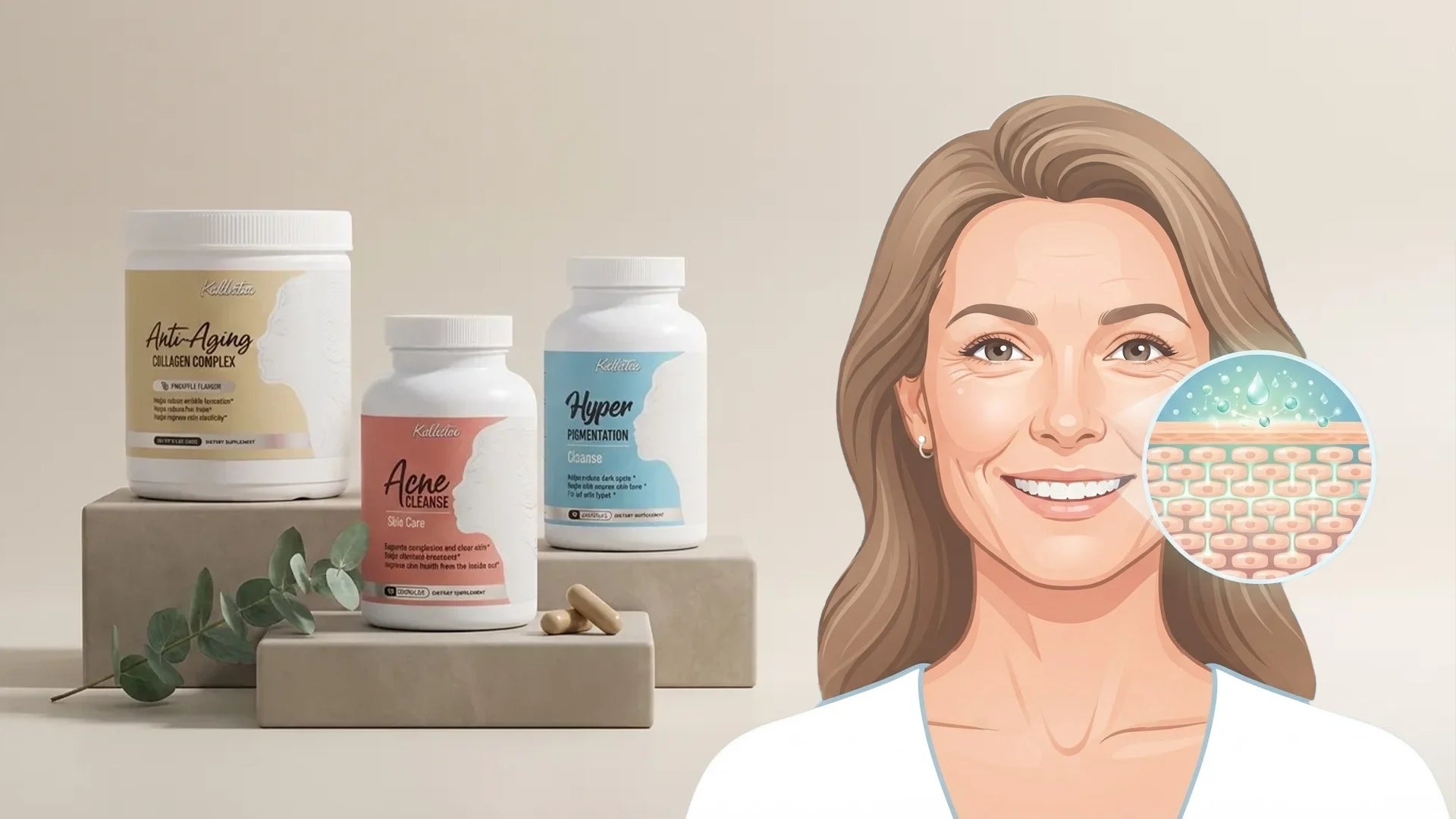
These are core ingredients in my Perfect Skin Kit. With its blend of 42 natural ingredients, the Kit has been specifically formulated to help with all of the causes of an uneven skin tone. It nourishes from the inside, so unlike harsh topical treatments, it is strengthening and supporting the skin barrier as it works.
Now I know what it is like to try everything with zero results, so I have a 45 day money back guarantee so you can try them for yourself with zero risk involved.
Talk soon,
K xx